| TIPS & RIGGING TECHNIQUES |
Is it a Head or Tail? How to rig a worm
By Curtis Welch
A proper technique for adding a night crawler onto any spinner rig, such as a Wally Pop or Cha Cha, is to first identify the head of the crawler. That can be accomplished by noting the head will be darker, more pointed, and has rings continuing down to a smooth spot. The tail of course, will be lighter, and flatter.
First you insert the top hook into the head by the first or second ring. Go all the way through the worm and have the hook point exit upward toward the head of the worm. Next it is important for the worm to be stretched out. One way this can be done is by dipping or dragging the worm in the water. The second hook is than inserted half way through the worm pushed in the direction from head to tail, and than poked back out the same side it went in.
Important Note: To keep the worm from spinning, it is critical that the worm lies straight when being pulled through the water.

HUMMBAIT AS AN ATTRACTOR
By Larry McClintock
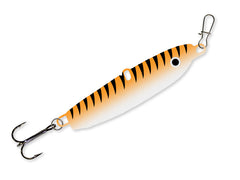
The HummBait is a fantastic lure and it has all types of applications. It can be jigged, cast and retrieved and trolled. It can also be used an attractor for a worm harness.

There is another application for this lure as well and that is by using it as an attractor. Below are three different applications of using the HummBait® as an attractor.

3/8 ounce HummBait® with 18 inch leader 3/8 ounce HummBait with an 18 inch
to the Smile Blade® worm harness leader to a Mosquito worm harness
You can connect the HummBait® directly to your bottom bouncer or use a leader to drop it back a little more but you will need to use a bead chain if you drop it back. You will also need a bead chain behind it if you use the Hot Wing Blade® or the Smile Blade®.
The length of the leader from the HummBait® to the worm harness will vary but I like to use 18 inch leader with a 24 inch maximum.
There are other variations that can be created using this fantastic multi purpose lure.

3/8 ounce HummBait® with an 18 inch leader to a Smile Blade® worm harness with a cork float.
SMILE BLADE RIGGING TIPS
By Mack's Lure
As many of you have already noticed on most of Mack's Lures packaging contains great information and useful tips on how to use our products. Below is an example from our Smile Blade package.
The Carolina and Texas are great rigs for Bass. The float rig for walleye. The trolling for trout and the egg cluster for Steelhead.


HOW TO ADD A SMILE BLADE TO YOUR STICK BAIT
By Bill & Bernadine Ayers
At the many seminars we do promoting Mack's Lure, one of the tips that we pass along creates quite a bit of buzz. It is the one where we put a small 0.8 Smile Blade behind a stick bait. This little addition to their favorite lure gives the illusion of a tail in swim mode. After the seminar I encourage those who want to learn this method to meet with me so I can demonstrate to them just how it is tied. This creates quite a traffic jam at the Mack's Lure display. Anglers want to know how to tie the Smile Blade tight to the stick bait so I will also share how with you.
The items needed are; a 16" piece of 14# power pro braid, a 0.8 Smile Blade, (we have found gold and silver sparkle series work the best), and a 4mm ruby red bead (also available through Mack’s.).
Step 1: Remove the treble hook and store the split ring for some other time. With one end of the #14 braid, tie a palomar knot to the tail end of your stick bait. Tighten and trim the tag end.

Step 2: Slide the Smile Blade on the string with the sparkle facing the knot you just tied. Slide the 4mm bead on behind the Smile Blade.

Step 3: Tie another palomar knot on the treble hook --- with one exception. Start out as usual with the tag end through the eye then back through. Now, with a loop in one hand and a tag and main line in the other, tie an over hand knot. Right here is the secret; instead of putting the loop back over the treble to cause the knot to 'lock' in place; hold the loop and separate it and randomly choose one side of the loop. Hold the treble with one hand and pull on the side you have chosen. If the tag end gets shorter, you've chosen the wrong side. Continue to hold the treble and pull the other side of the loop. Keep pulling until the treble is tight against the red bead. Hold the treble and pull the tag end adjusting the loop as it gets smaller so it doesn't entangle the bead or Smile Blade and settles nicely on the eye of the treble. Pull tight.

Step 4: Cut the tag end off and holding the stick bait, pull on the Treble. You'll feel a little more locking of the palomar knot and you'll get just enough slack to let the Smile Blade spin free.
You can use the larger 1.1 Smile Blade on the larger stick baits, or any of the ones with violent side to side action. We put the Smile Blades on all our stick baits except the smaller flat fish type. We always tell seminar participants that no one fishing lure will catch all the fish all the time, but this technique will raise your catch rate like it has ours.

Additional Images:


TIPS ON SMILE BLADE APPLICATIONS
By Ron Stirtz
Mack's Lure offers a variety of ready made lures which feature Smile Blades®, but if you are one of those fishemen who likes to rig his own tackle, here are a few suggestions.
Small spoons: Many assume that small spoons wiggle properly when trolled. This usually is not the case. They do well when cast and retrieved, but usually do virtually nothing at 1/2 to one mph. The fix is easy. First run an appropriately sized smile blade up your leader followed by two small (4 mm) beads. Now tie directly to the split ring on the front of your spoon, and you have a truly active low speed lure. Note that now the action is produced from the front of the lure, so adding a small piece of bait to the hook is just fine. This is a super lure for Kokanee.
The all purpose smiley rig: This rig is simply a length of leader (6 lb or heavier), a smile blade, two small beads and a ring eye (not turned up or down) baitholder hook. For worm applicatinon nip off a length of worm equal to one and one half the leth of the shank. Run enough worm to cover the shank, pierce the worm and run the worm up to the hook eye. You should now have a nice straight bait with a tail sticking out past the end of the hook. This will give you an incredible real food action lure as you troll it.
The minnow helper: Everybody who fishes a minnow fishes a dead minnow. Like it or not very soon after you start trolling a minnow, he dies. It's probably something about having holes punched in his body and his gills not functioning under stress, but the reason doesn't really matter. He's dead. Using the smiley rig described above you will have a minnow that always looks lively. If you hook your minnow up through the jaw and out the top of the nose, use a light wire short shanked hook. If you go in the mouth, out the gill and back through the body, use medium to long shanked light wire hook. We recommend light wire so as much energy as possible transfers from the blade to the minnow.
Troll a fly with 'tude'. Many fishermen have discovered that trolling their favorite flies can be quite productive. Put that fly on a smiley rig instead of the ring iye hook, and you have the most incredible fly presentation ever. Some flies that have worked well for us include the wooly worm, wooly bugger, and marabou streamers. Colors? Try black or moss green. In spite of what the pegs at the local fishing store look like, a great part of a fishes diet is dull colored not hot pink or green. Be sure to take a moment to look at you rig in the water at troll speed. You will be excited and so will the fish!!!
BE SURE TO USE THE FLASH LITE TROLL AHEAD OF ANY OF THESE APPLICATIONS FOR EVEN MORE STRIKES.
Walleye Central
Mayfly Madness by Keith Segar
The month of June can be a frustrating time to target Walleye's on Lake Erie's western basin. Massive Mayfly hatches coat the water surface with spent casings, and the shores are filled with dead carcasses. While the fishing can be tough it's not hopeless, as some would have you believe. Changing tactics during this time of plenty can make the difference between catching fish, or going home empty handed.
Now is the time for walleye anglers to take a lesson from their Trout fishing brethren. That's right, were going to do what any dyed in the wool dry fly trout fisherman would do and "match the hatch". Downsizing your offerings at this time is crucial to success. The fish are keying in on the emerging larvae that are approximately an inch long, and are predominately gold, or copper color. Many knowledgeable Erie anglers will switch to spoons this time of year that have some, or are mostly made up of this color combination. Stinger Scorpions have been the most popular for a few years now, and they come in wonderful fish catching colors that have equally colorful names. Shrimp and Confusion are two of my favorites.
Trolled behind planer board with snap weights to reach the desired depth is how I usually rig them for this application. Some fishermen will use a three way with a deep diving crank such as a Reef Runner on the bottom with the spoon attached to the middle eye for a double up approach when trolling spoons.
Another top tactic is to cast, drift, or troll with small spinner rigs called "weapons", or "Mayfly rigs". Constituting of a short 12'-24' leader made with gold beads, and a single hook they are normal outfitted with a small #0, or #00 gold Colorado blade so that it resembles a Mayfly. Anglers usually drag one of these outfits along the bottom while casting and retrieving a second one for an effective pattern when the wind is strong enough to allow you to drift. The hook I like to use with this rig is the standard bait holder in size #6 or #4 so that it helps to keep the overall size small. It is important to only use a small piece of night crawler on this hook as well, or the spinner will not be as effective.
Trollers can still get in on the action, especially on days when there isn't much wind by trolling smaller baits with metallic finishes. Reef Runners little Rippers, and Deep little Ripper's have proven to be some of the most favored on the Great Lakes. Gold Clown, Watermelon, and Orange Juice are my favorites.
Another tactic I have found especially effective during this time is trolling with "Smile" blade spinners from Mack's Lures of Leavenworth, WA. These blades are made of Mylar wings, and come in three different sizes plus a multitude of colors. I like to take a 36" long leader and add 3 or 4 gold beads, a single hook then top it off with a small gold, or amber smile blade. If the water is a bit stained I will change the makeup slightly. I'll use a single gold stack bead with one fluorescent chartreuse bead at the end right before the hook. This will add a little color to the presentation without increasing size, which still remains the important factor here.
This spinner rig is extremely light in weight, and will spin at the slowest of speeds creating a deadly presentation. I will run a lead of about 50' out then attach an Off Shore snap weight, then another 50' of line to an in-line planer board. Slow trolled at speeds under 1 mph give fish additional time to locate, and take the bait. I will often take my Yamaha 4-stroke kicker out of gear and let the spinners start to slowly fall to the bottom with a fluttering action then put it in gear and start moving forward again to create the illusion of rising mayflies. This extra motion added to the spinners has on more than one occasion meant the difference between a good day, and a great day on the water.
A casting version of the same spinner rig tied with a smile blade can really help on the days when there isn't much wind to drift with. Attaching a ¼ to ¾ oz. sinker ahead of a snap swivel allows you to create your own casting rig with the ability to switch leaders, or spinners as you wish. Lighter than any metal blade these spinners can be retrieved much slower allowing your bait to stay in the strike zone longer, and give you more hookups.
So the next time you see evidence of the hatches taking place, and the fish seem to have developed lockjaw try some of these presentations to help put a few in the box. Remember the hatches won't be around long; just don't let them "bug" you!
Soaring Eagle Guide Service
Ice Fishing Rigs for Tip-Ups
Welcome to the Guide's Corner Page, and as you know, there is a new fishing season in the northern part of the country. Yes, I am talking about hard water, or more commonly known as, ice fishing. In this article you will find techniques that I have been using on my tip-ups which wil help you catch more fish. The leader line rigs I use is what I will go into detail on how to set up. These rigs have been tested by, moving the rig from a spot where I had been catching walleyes on the rig, to a different spot where I was fishing with a traditional plain hook and minnow and not catching any fish. After I switched spots with the different set ups, I started catching walleyes with the special rig in its new spot, and the plain hook and minnow went for naught in the spot where I had just been catching fish. Now a plain hook and minnow will catch fish, but after a test like this, wouldn't you want to up the odds in your favor? Each of the rigs I will discuss, have been proven to really catch any type of game fish through the ice. First, we will cover how I set up my under water tip-up before we get to the rigs at the other end. I spool my tip-ups with braided nylon ice fishing line, anywhere from 15-30 pound test. The braided line will stand up to the sharp edges of ice that can cut monofilament line. When you catch a bigger fish, you will be pulling on the line to bring the fish in, but then you may have to let the fish have line as not to break your leader line. As you let that line out with a slight tension to tire the fish, the line you just pulled in will be lying on the ice and its sharp edges. This is where braided line will keep you n the game. Next you will need to put a line marker on the braided line. The marker is used to mark the amount of line you have out to fish at a certain depth, so that after you catch a fish, you can reel in the line to the marker and start fishing without checking the depth again. I have used all different type of markers, but a slip bobber knot works the best. You can slide the knot up and down the line as you fish in different depths. So, leave the tag ends on the knot and that way you can retighten the knot if need be. The braided line is of larger diameter, which may spook some fish; that is why you will want to run a leader line of smaller diameter at the end of the braided line. The one thing nice about leader lines is that you can pre-rig them ahead of time. They can be rigged with different types of line, rigs, or colors depending on the moods of the fish. Tie on a snap swivel at the end of the braided line, this will allow you to change leader lines quickly when necessary. These leader lines is where the rigging comes in to play.
All of my leader lines start out with a
barrel swivel tied to the one end. This allows me to change the lines with
the above mentioned snap swivel. Also the swivels keep out line twist from
the swimming minnows. Another item on all the rigs is a chunk of split
shot. Some weight is needed to keep the swimming minnow down in the strike
zone and size of split shot is to the size of the minnow. Larger minnows
can swim around all over the place and require more weight than you should
use. To combat that situation, I will take a scissors and cut off some of
the tail fin. This allows the minnow to still swim around to attract fish
while staying in the preferred strike zone with a smaller weight. One more
thing before I get into the final rigging of these leader lines, is the type of
line to use. All the rigs can be usedon monofilament or super
lines. Clear water combined with finicky walleyes may require monofilament
line. A lot of the waters I fish have both walleyes and northern
pike. A northern pike will make a short life of a mono leader in a hurry,
or even a walleye, if the line is placed just right. I have found that
using 14 pound test Berkley FireLine will with stand the toothy critters.
The 6 pound diameter is still thin enough to catch the spooky walleyes.
Now we can get into rigging the rest of the leader line. The firstrig is
simple but effective. It consists of the barrel swivel, 18-36 inch leader
line, split shot and a Mack's Lure Glo Treble Hook. The Mack's Glo Hook
will allow fish to zero in on your bait when fishing at night, low light, or
cloudy water conditions. With a good charge from a light source, the glow
will last a half hour or longer. My favorite colors are Maggot White and
Hot Cerise.
The next two rigs are a little more
complicated but similar with slight variations. Both rigs use aMack'sLure Smile Blade. The Smile Blade acts as an attracter as the light
reflects off the easy turning blade while the minnow swims around. Again,
both rigs start with a barrel swivel tied to one end of a 18-36 inch leader
line. Next, slide one 4mm bead on to the line. Then put the Smile
Blade on with the fold of the blade pointing up towards the barrel swivel.
Slide on five more 4mm beads and then tie on a treble hook. You need the 5
beads to keep the blade from covering up the hook so that the hook points are
exposed for when it is time to set the hook on a fish. It is important
that you use a 4mm bead on both sides of the Smile Blade so you don't inhibit
the action of the blade. Then put your split shot on the leader line
between the barrel swivel and the first bead.
The next rig is an adjustable version of
the one we justwentthrough. After the barrel swivel is tied on to the
18-36 inch leader line, slide on one or two 4mm beads. Then slide on the
Smile Blade with the foldpointing up to the barrel swivel. Next, slide on
two more 4mm beads and then a slip bobber knot. Pull the knot tight and
trim off the tag ends. Tie the treble hook on and now you can slide the
knot up or down toplace the blade at different heights on your leader
line. Just keep in mind when you put your split shot on above the first
bead, of where you would like to place your blade as you position it on the
leader line. Also, don't place the blade to low on the line as to cover up
the hook points. Either one of the last two rigs can have a Mack's Lure
Glo Treble Hook tied on to the business end for further fish attraction.
As far as blade colors, the traditional gold and silver are two colors to start
with as well as chartreuse, orange, and glow in the dark.
Smile Blades come in a variety of colors and finishes with four
different sizes to meet your fishing needs. All the Mack's Lure products
along with bobber stop knots and beads can be purchased at their website.
Just follow from the Home Page to the Sponsor Page for a direct link to the
Mack's Lure website. Now you are armed with some leader line rigs that
will help you catch more fish this winter, because I know these rigs have for
me. Contact information for Soaring Eagle Guide Service can be found on
the About Us Page if you have any questions about the rigs and its components or
your guided ice fishing needs. |
The John Day Special
Catch More Bass & Walleye

The John Day Special ready to fish.
The John Day Special came about from the joint efforts of Mah-Hah Outfitters Guide, and Mack's Lure Pro Staff Steve Fleming and Larry McClintock. This lure seen here tied with black line for visibility, has 5 components. The lead head is a Charlie Brewer Slider , the line is 14 pound test, or whatever you desire, 3 MM black plastic beads, a 1.1 Smile Blade® and a #6 black chain swivel from Mack’s Lure®.
The knots used for both the Slider and the bead chain are polomar and the typical length of the leader is 18 inches. This is a great rig to use for casting and retrieving for walleye and bass and can be rigged weed less for casting into heavy cover. This lure has been responsible for many smallmouth bass over 19 inches and as big as 23 inches plus.

The John Day Special components, Charlie Slider, 3mm black plastic beads, #6 chain swivel. The Smile Blades® here are some of the most used ones in this setup, but all will be effective. You can also use the 0.8 Smile Blades® for more of a finesse rig and the 1.5 for a bolder presentation.
When you are fishing with 4 line counter rods, trolling with planer boards and the fish are hitting on one certain rod you want to know what that presentation is, so you can recreate it on another rod.
Here is how we keep tract of our rods. Before we began fishing we set up our rods, and in our notebook I write what each rod has on it. We have our rods set-up with a strip of visible tape by the reel; black, blue, red, and green. So I write Black--and its presentation, and how far back, then Blue--and so on. Because when you are busy fishing and pull in one planer board to take off weeds, and put it in another rod holder to handle another rod, it is easy to forget what presentation it has on it, and how far back it was set.
So when we catch a fish on example the rod with the green tape, we know all the information so we can duplicate it on the ones that aren't working.
Pre-fishing for a tournament is very valuable time for us, and the small amount of time it takes to write things down pays for us in the long run. We keep tract of what works for us, and call it fishing smart.
Mack's Lure Pro Staff Members of the Year,
THE MOSQUITO

The Mosquito is a worm harness with either # 4, #2 or #1 hooks, Mack’s Lure stack beads a 5 mm bead in the middle and a 3mm or 4 mm bead in the middle then another 3mm or 4 mm bead against the hooks, this gives a long slender body and instead of using a Smile Blade® we use a Mack’s Lure Hot Wing® blade in its place. You can use either one or two stack beads depending on how large a bait you want to display. The center bead can also be a Mack’s Lure Wedding Ring® bead if you want a little more bang for your buck. The length of the lure depends on the size of presentation that you want to give the fish. The leader length can be from 24 to 60 inches. The long slender body and the long slender wings give this lure its name, the Mosquito and it is extremely effective for walleye and smallmouth bass. It can be rigged with a night crawler or a plastic and can be made weedless when necessary. The important part of this lure is the wings do not interfere with the first hook.

|